Where Can You Actually Mount a Dash Cam in California?
Most California drivers don't know that sticking a dash cam in the middle of the windshield is technically illegal — and that the law specifies exactly three places you're allowed to mount one. This post breaks down Vehicle Code 26708, the zones that matter, and the fine-print details most guides skip entirely.
Dash Cams SD
7/22/20264 min read
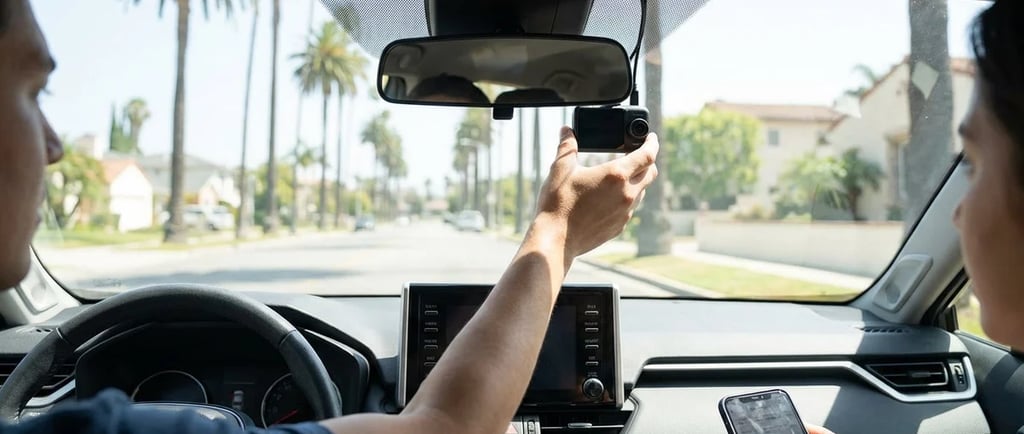
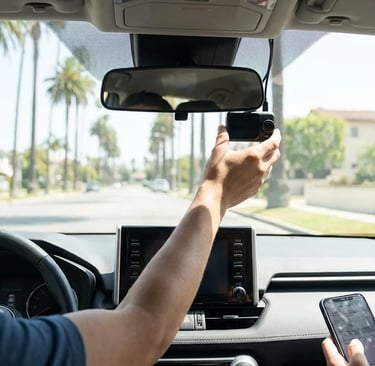
Most people rip open the box, lick the suction cup, and stick the camera dead center on the windshield. Makes sense — that's where you'd want the best view. It's also the easiest way to get pulled over for a windshield obstruction.
California doesn't ban dash cams. Not even close. But the state does care a lot about where you put one on your glass, and the rules are more specific than most drivers realize.
The law that matters: Vehicle Code 26708
Section 26708 is the statute that governs what can and can't go on your windshield. It covers everything from GPS mounts to tint to sun visors. Dash cams fall under subsection (b)(13), which carves out three specific zones where a "video event recorder" is allowed.
Three zones. Not four, not "wherever it doesn't bother you." Three.
Zone 1 — Passenger-side lower corner. A seven-inch square area in the lower corner of the windshield farthest from the driver. This is the most generous zone size-wise, but almost nobody installs a forward-facing dash cam here. The angle is off, and it catches a lot of hood.
Zone 2 — Driver-side lower corner. A five-inch square in the lower corner nearest the driver, and — this part gets missed — it has to be outside the airbag deployment zone. That second requirement matters. If your A-pillar airbag deploys and the camera is sitting on top of it, that camera becomes a projectile. Two inches of bad placement can turn a safety device into a hazard.
Zone 3 — Upper center, behind the rearview mirror. A five-inch square mounted to the center uppermost portion of the interior of the windshield. This is where 95% of dash cams end up in practice. Tucked behind the mirror, out of the driver's line of sight, clean sightlines for the lens. It's the sweet spot for a reason.
Mount outside those three areas and you're subject to citation under the general prohibition in 26708(a). Officers don't need to prove the camera actually blocked your view. The placement alone is enough.
What about dashboard mounting?
Here's the part that surprises people: the statute's placement restrictions only apply to the windshield. A camera mounted on your dashboard has no size or location rules under 26708, as long as it doesn't obstruct your view through the windshield or side windows.
So if your camera doesn't fit the windshield zones — maybe it's a larger unit, maybe you're running a digital mirror system — the dash is a perfectly legal alternative. The trade-off is usually a worse camera angle and more hood glare, but legally you're clear.
The passenger notice requirement nobody talks about
Buried in 26708(b)(13)(B) is a line that most dash cam owners have never read: a vehicle equipped with a video event recorder must have a notice posted in a visible location stating that a passenger's conversation may be recorded.
This is separate from California's two-party consent law under Penal Code 632. That's the criminal statute about recording private conversations. The notice requirement in 26708 is a civil/traffic matter — it's part of the conditions for your dash cam to qualify for the windshield exemption in the first place.
For most personal vehicles this comes down to a small sticker or placard. For fleet vehicles and rideshare drivers, it's not optional. It's the kind of detail that becomes relevant exactly when you don't want it to — during a disputed insurance claim or a lawsuit where the other side's attorney is looking for any angle to suppress your footage.
A quirk in the statute worth knowing
The law defines "video event recorder" in a very specific way: a device that continuously records in a digital loop, records audio, video, and G-force levels, and saves video only when triggered by an unusual motion or crash or when operated by the driver. It also says the device shall store no more than 30 seconds before and after a triggering event.
Read that again. Thirty seconds before and after.
Every modern dash cam — Viofo, BlackVue, ThinkWare, all of them — records continuous loop footage in one- to three-minute segments and stores hours of video, not sixty seconds. By a strict reading of the statute, most consumer dash cams don't actually meet the definition of "video event recorder" that the exemption was written for.
In practice, this hasn't been a real enforcement issue. Courts and officers treat dash cams as dash cams regardless of how much footage they retain. But it's an unresolved gap in the law, and it's the kind of thing that matters if your footage ever ends up in litigation and the opposing counsel is creative.
Does any of this actually get enforced?
Short answer: yes, but usually as a secondary citation. Officers aren't cruising around looking for badly mounted dash cams. But if you get pulled over for something else and the officer notices a camera suction-cupped to the middle of your windshield at eye level, that's a windshield obstruction citation — typically a correctable fix-it ticket.
The more meaningful consequence is what happens after an accident. If your dash cam was illegally mounted and the footage shows the incident, the defense has an argument that your own view was obstructed. Your evidence becomes their evidence. That's a bad trade.
The bottom line
California wants your dash cam behind the rearview mirror, in a lower corner, or on the dashboard. The zones are specific. The notice requirement is real. And proper installation isn't just about keeping the camera from falling off — it's about making sure the footage holds up when it counts.
Getting a dash cam is the easy part. Getting it mounted in the right spot, hardwired so it's not dangling a cable across your dash, routed so no wires are visible, and positioned within the legal zones — that's the part most people skip and regret later.
We install dash cams for a living. Every install we do in San Diego follows CVC 26708 placement rules, routes cables behind panels so nothing is visible, and hardwires through the fuse box so there's no cigarette lighter adapter cluttering up your console. If you've been sitting on a dash cam in a box or you're thinking about getting one, we can handle the whole thing — camera, hardwire kit, and a clean install at your location.
Professional dash cam installation for your safety and peace of mind while on the road
Serving San Diego and nearby areas
We are here for you:
© Copyright 2026
All rights reserved by Dash Cams SD LLC
Mon-Sat: 9 AM - 7 PM
Sun: Closed


SAN DIEGO, CA